Mining school graduates earning more than Harvard counterparts
The mining boom of the last decade and a senior workforce that is retiring at a rapid pace has left many mining companies in desperate need of qualified people. For those just coming out of school with mining engineering degrees this is great news.
A recent study by PayScale Inc. found that things are so good for some mining-focused graduates that they are earning a better starting salary than graduates from Harvard University.
The study compared Harvard graduates to those from the South Dakota School of Mines & Technology.
Those leaving the South Dakota School of Mines & Technology, a college of 2,300 students, this year got paid a median salary of $56,700, according to PayScale Inc., which tracks employee compensation data from surveys. Median salary for those graduating from Harvard, where tuition fees are almost four times higher, was $54,100.
Those scheduled to leave the campus in Rapid City, SD, in May are already getting offers, at a time when about 1 in 10 recent U.S. college graduates is out of work, Bloomberg reported.
A fourfold gain in commodities in the last decade reflects both surging demand and the industry’s failure to keep up. Although new mineral deposits are getting harder to find, companies also are struggling to add enough skilled workers. That’s partly a legacy of U.S. colleges cutting back on mining programs. There were fewer than 28,000 people employed in U.S. metals mining in 2004, down from 58,000 in 1993, the National Mining Association estimates. By 2011, it had rebounded to 40,000.
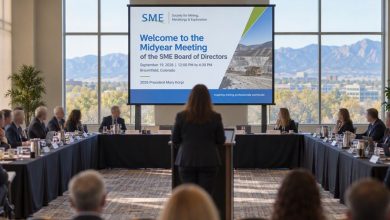
As many as 78,000 additional U.S. workers will be needed by 2019 to replace retirees, the Society of Mining, Metallurgy & Exploration (SME) said in a report in January. In Australia, the largest shipper of coal and iron ore, there will be a shortfall of 1,700 mine engineers, 3,000 geoscientists and 36,000 other workers in the five years ending in 2015, the report said.
Demand for mining-school graduates is exceptional in the U.S., where the unemployment rate for people ages 20 to 24 with bachelor’s degrees was 11.8 percent in July. The jobless rate across the economy held above 8 percent for a 43rd consecutive month in August, government data show.
Click here for the full Bloomberg report.